
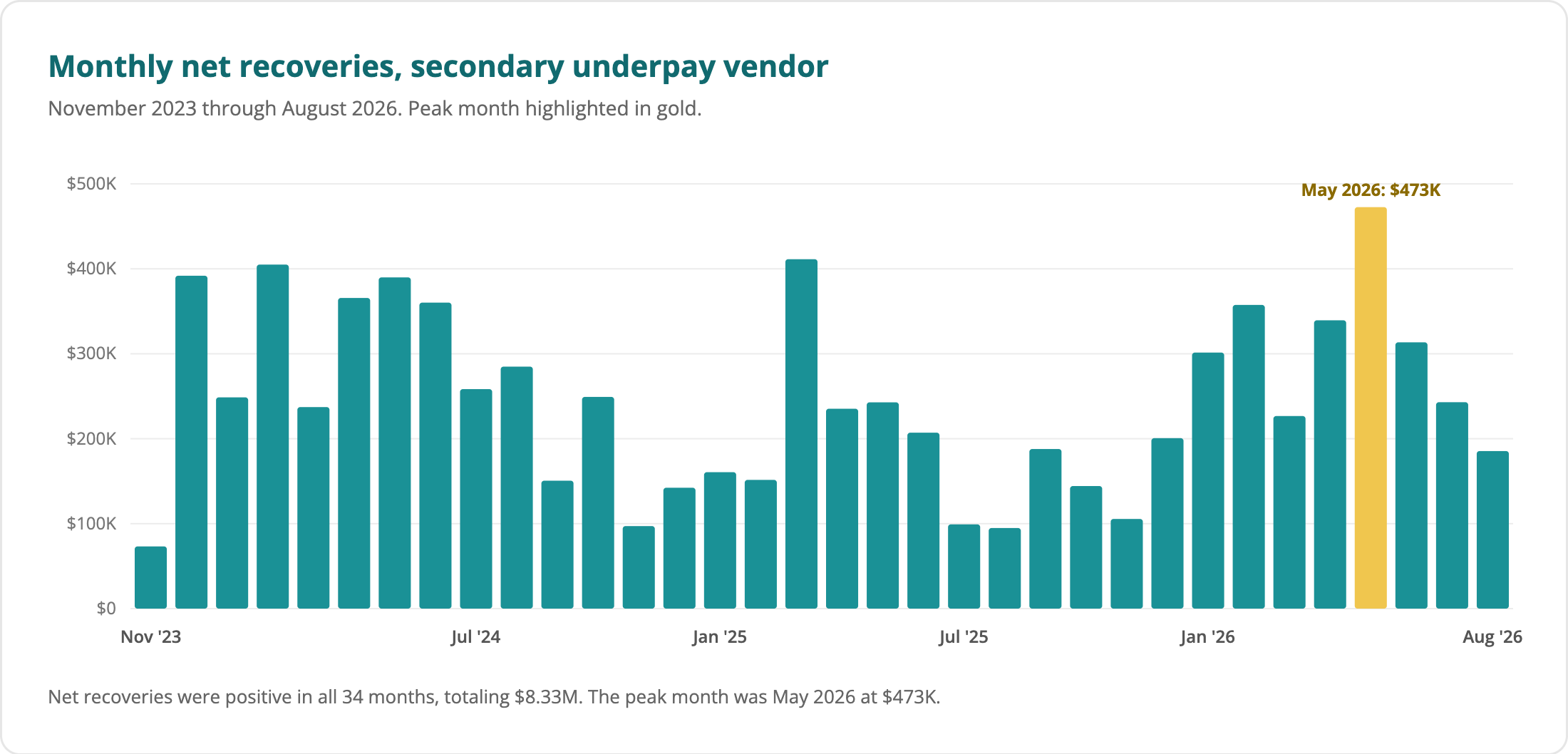
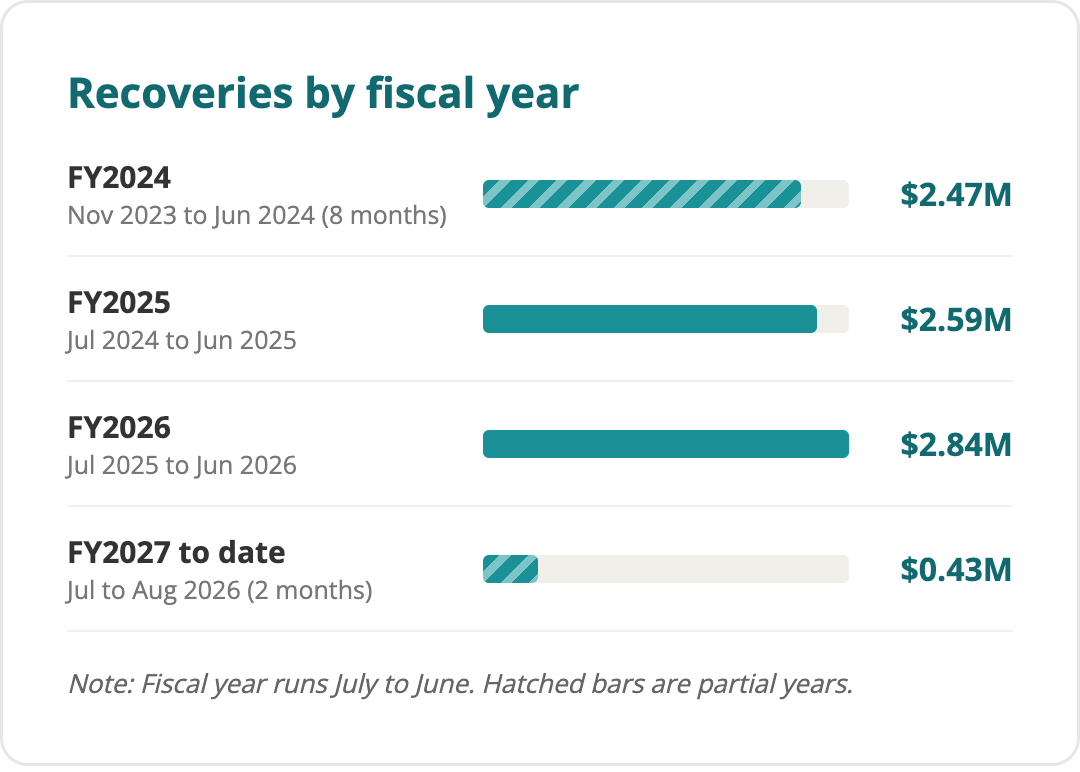
$8.33 Million Net To Date Across 34 Months of Reporting
Lorem ipsum
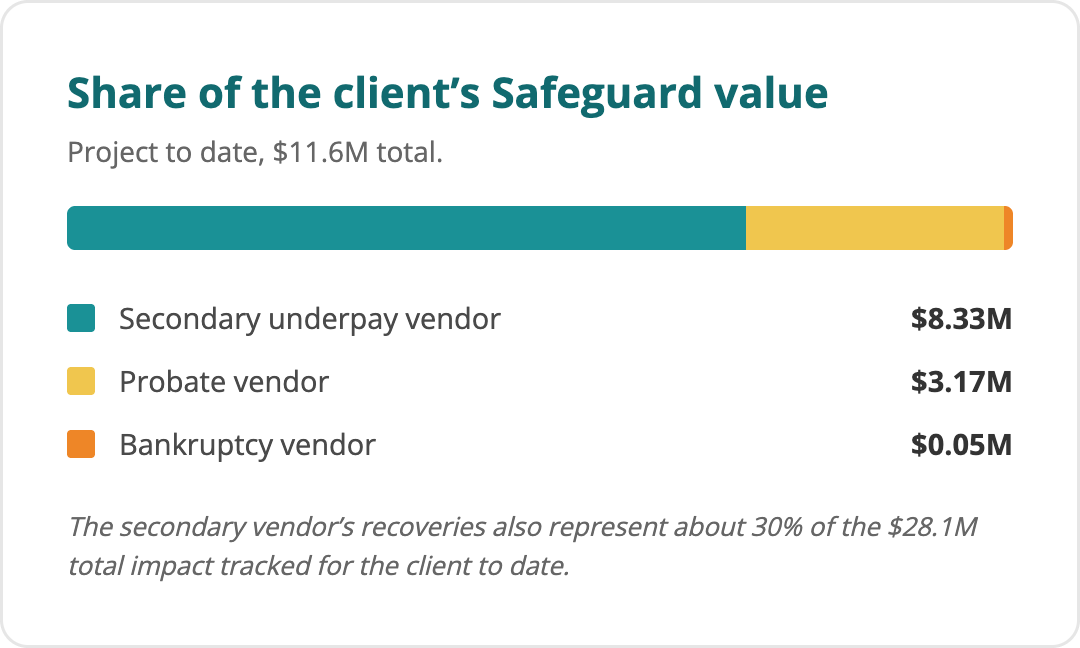
net underpayment recoveries from the secondary vendor, Nov 2023 to Aug 2026
Lorem
months with positive net recoveries since the secondary vendor began reporting
Lorem ipsum
recovered in the trailing 12 months (Sep 2025 to Aug 2026)
Lorem
of the $11.6M in Safeguard value Healthfuse has tracked for the client
The question wasn’t whether the primary vendor was performing. It was whether any single queue could reach every recoverable dollar.
That is a structural limit, not a performance one. Contract modeling gets harder with every DRG and case-rate term, implant or drug carve-out, and payer-specific policy. Claim volume outruns manual review. And with payer appeal windows that typically run 60 to 180 days, a single vendor’s queue tends to leave a tail of accounts that go unworked or unresolved while the window to recover them closes.
Healthfuse’s goal was to recover that tail without disrupting what was already working: keep the primary vendor in place and add coverage behind it.
01
Incremental by design
Misaligned incentives
02
The clock is the constraint
Classification error
03
Lorem ipsum
Contract risk
04
Lorem ipsum
SURPRISE BILLING
Keep the primary vendor, tighten its clock, and add a second layer of expertise behind it.
i
The primary underpay vendor stays in place across the client’s entities.
ii
Healthfuse reduced the time the primary underpay vendor has to work accounts to 120 days, which accelerated the work happening at the primary level.
iii
The secondary underpay vendor works the underpayments the primary vendor missed or couldn’t overturn, adding a second layer of expertise.
iv
Secured rate reductions on a key segment of the patient population and unbundled previously combined groupings so fees are applied more fairly and transparently, and only when they’re actually earned.
Recoveries began in the first month of reporting and have continued every month since.
Lorem ipsum dolor sit amet
Lorem ipsum dolor sit amet
Lorem ipsum dolor sit amet
Lorem ipsum dolor sit amet
From sourcing to a steady run rate.
Three things any multi-entity system can borrow.
Layer, don’t replace
The primary vendor stayed in place. The secondary vendor added coverage behind it rather than starting over.
Put a clock on the primary
A defined 120-day work window keeps the first pass moving and hands unresolved accounts to the next layer sooner.
Track each layer separately
Reporting the secondary vendor on its own shows exactly what it adds on top of the primary.
Not sure what your payers still owe you?
Let our team run an analysis to determine if secondary underpay makes sense for your health system.