
From the highest-spend vendor to $7.8M in projected annual savings.
When a patient financing program quietly grew into our client’s most expensive vendor relationship without delivering proportional value, Healthfuse uncovered the structural pricing flaws, recovered overcharges, and reset the contract on terms that work for both sides.
Patient Financing Vendor
$7.8M
Projected annual savings
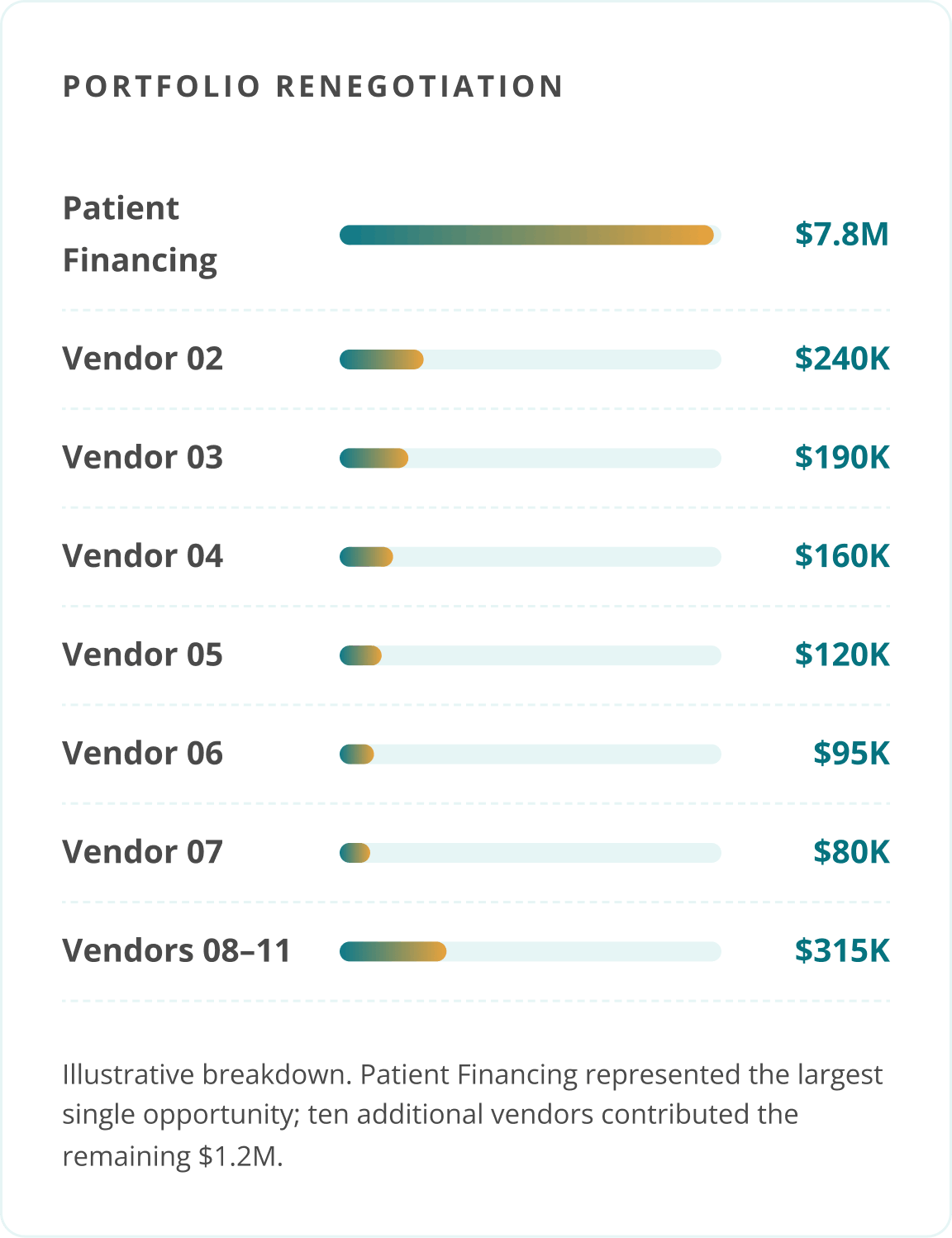
Portfolio Expansion
$1.2M
Additional annual vendor contract savings across 10 vendors
The Challenge
A vendor relationship quietly tilting out of balance.
Our client’s patient financing partner had become the health system’s highest-spend vendor. The program was still generating substantial cash for the hospital, but the health system was paying a steep premium for every dollar collected, and the economics had drifted out of balance. A closer look revealed four structural problems compounding the cost:
01
Approving the wrong patients
Inappropriately high approval rates for the lowest-propensity-to-pay patients were eroding the vendor’s margin while inflating the highest-contingency fees passed back to the health system.
Misaligned incentives
02
Inpatients billed as ED
Inpatient accounts were being incorrectly classified as high-risk Emergency Department visits at the verifier step in Patient Access, triggering inflated, incorrect contingency fees.
Classification error
03
PR Implications
Public backlash after patients (particularly the ED population) misunderstood their financing agreements, leading to credit reporting hits. To resolve, the client negotiated to halt credit reporting, though this came at a cost to the vendor’s ability to assess patient credit worthiness.
Contract risk
04
Surprise Surcharge
Blindsided by an unexpected $50K/mo. fee tied to the vendor’s credit reporting stoppage.
SURPRISE BILLING
Our Approach
Four targeted adjustments: restored alignment, recovered dollars.
i
Tightened eligibility for low-propensity-to-pay patients by 10%
Reduced approvals for the lowest-propensity-to-pay patients, lowering vendor risk exposure and trimming the contingency fees the client was paying on the highest-cost segment.
Effect
Lower contingency fees
ii
Eliminated the verifier misclassification
Corrected Patient Access workflows so inpatient accounts no longer flow through as high-risk ED, removing overcharged contingency fees at the source.
Effect
Overcharges removed
iii
Eliminated the $50K/month credit-reporting surcharge
Negotiated full elimination of the surprise surcharge and secured a retroactive waiver of the first $50K invoice, converting a PR crisis into a clean reset.
Annual savings
$600,000
iv
Renegotiated fee structures and unbundled patient groupings
Secured rate reductions on a key segment of the patient population and unbundled previously combined groupings so fees are applied more fairly and transparently, and only when they’re actually earned.
Effect
Fairer fee structure
Results
Realigned economics, on a footing that lasts.
The renegotiated contract eliminated structural overcharges, restored fee transparency, and put the client and vendor back on a footing where both sides win when the program performs.
$7.8M
Projected annual savings with patient financing vendor
$600K
Annual savings from surcharge elimination alone
$50K
First invoice waived retroactively
10%
Reduction in approvals on low-propensity accounts
Beyond One Vendor
One contract review,
10 more opportunities.
The patient financing engagement surfaced patterns —
surprise surcharges, misclassifications, bundled tiers — that
almost never live in a single contract. Healthfuse extended
the review across the full vendor portfolio.
The result: 10 additional vendors where contract terms could be strengthened, delivering meaningful savings while preserving the operational service relationships the health system depends on.
$1.2M
Additional ANNUAL savings identified
10
Vendors flagged for renegotiation
0
Service relationships disrupted
The Takeaway
When the highest-spend vendor stops paying back, the answer isn't to walk away, it's to look closer.
Most patient financing relationships were architected for a different era of approval policy, classification accuracy, and credit reporting. A disciplined review, at the contract, the workflow, and the invoice almost always finds dollars that should never have left the building. And once one vendor is examined that way, the rest of the portfolio rarely looks the same again.